 Add to Chrome
 Add to Firefox
 Add to Edge
Ex-GraphRAG: Interpretable Evidence Routing for Graph-Augmented LLMs
May 21, 2026
GraphRAG conditions language models on subgraphs retrieved from knowledge graphs, encoded via message-passing GNNs. Because these encoders entangle node contributions through iterated neighborhood aggregation, there is no closed-form way to determine how much each retrieved entity influenced the encoder's output, and therefore no way to faithfully audit what structural evidence actually reached the model. We introduce Ex-GraphRAG, which replaces the GNN encoder with a Multivariate Graph Neural Additive Network (M-GNAN), an extension of additive graph models to high-dimensional embedding spaces that yields an exact decomposition of the encoder's output across individual nodes and feature groups, without post-hoc approximation. On STaRK-Prime, this auditable encoder matches black-box performance. Using it to audit evidence routing, we uncover a semantic-structural mismatch: the nodes that dominate the encoder's output are structurally disconnected in the retrieved subgraph, held together by low-attribution intermediaries whose removal degrades multi-hop QA by up to 28%. This mismatch, invisible to any opaque encoder, reveals that semantic importance and structural connectivity are governed by disjoint sets of nodes, with direct implications for retrieval pruning, context construction, and failure diagnosis in graph-augmented LLMs.

KAPPS: A knowledge-based CPPS Architecture for the Circular Factory
May 21, 2026While linear manufacturing relies on homogeneous materials and predefined process sequences, circular manufacturing reintroduces used products with heterogeneous and uncertain conditions. This shift demands manufacturing systems capable of handling variable product states, dynamically reconfigurable processes, and the integration of human and machine knowledge. Conventional manufacturing IT architectures, designed for stable structures and deterministic execution, are unable to meet these requirements, as they cannot adequately represent and manage the uniqueness of individual components at runtime. Following a design science methodology for developing a Cyber Physical Production System for circular manufacturing, we derive 14 requirements from five complementary perspectives. Based on these requirements, we design KAPPS, a knowledge-based architecture that uses an ontology-grounded knowledge graph as a unifying data backbone, combined with a semantic interface layer to enable consistent data and information integration, reasoning, and communication across heterogeneous systems and services, turning the knowledge graph from an integration layer into the factories authoritative write-time state. KAPPS incorporates modules for constraint enforcement and event-driven planning, enabling incremental adaptation of execution plans under uncertainty and human-machine knowledge exchange. The applicability of KAPPS is demonstrated through two implemented use cases: (i) Anomaly detection and learning through knowledge graph mediated services and (ii) runtime constraint enforcement in a modular conveyor system. Subsequently, the architecture is evaluated against the 14 requirements (ed. abstract shortened)
Leveraging Graph Structure in Seq2Seq Models for Knowledge Graph Link Prediction
May 18, 2026We introduce Graph-Augmented Sequence-to-Sequence (GA-S2S), a novel framework that integrates a T5-small encoder-decoder with a Relational Graph Attention Network (RGAT) to improve link prediction in knowledge graphs. While existing Seq2Seq models rely solely on surface-level textual descriptions of entities and relations and at best, flatten the neighborhoods of a query entity into a single linear sequence, thereby discarding the inherent graph structure, GA-S2S jointly encodes both textual features and the full $k$-hop subgraph topology surrounding the query entity. By integrating raw encoder outputs with RGAT's relation-aware embeddings, our model captures and leverages richer multi-hop relational patterns and textual information. Our preliminary experiments on the CoDEx dataset demonstrate that GA-S2S outperforms competitive Seq2Seq-based baseline models, achieving up to a 19\% relative gain in link prediction accuracy.
FutureSim: Replaying World Events to Evaluate Adaptive Agents
May 14, 2026AI agents are being increasingly deployed in dynamic, open-ended environments that require adapting to new information as it arrives. To efficiently measure this capability for realistic use-cases, we propose building grounded simulations that replay real-world events in the order they occurred. We build FutureSim, where agents forecast world events beyond their knowledge cutoff while interacting with a chronological replay of the world: real news articles arriving and questions resolving over the simulated period. We evaluate frontier agents in their native harness, testing their ability to predict world events over a three-month period from January to March 2026. FutureSim reveals a clear separation in their capabilities, with the best agent's accuracy being 25%, and many having worse Brier skill score than making no prediction at all. Through careful ablations, we show how FutureSim offers a realistic setting to study emerging research directions like long-horizon test-time adaptation, search, memory, and reasoning about uncertainty. Overall, we hope our benchmark design paves the way to measure AI progress on open-ended adaptation spanning long time-horizons in the real world.
Geometric Structural Knowledge Graph Foundation Model
Dec 28, 2025Structural knowledge graph foundation models aim to generalize reasoning to completely new graphs with unseen entities and relations. A key limitation of existing approaches like Ultra is their reliance on a single relational transformation (e.g., element-wise multiplication) in message passing, which can constrain expressiveness and fail to capture diverse relational and structural patterns exhibited on diverse graphs. In this paper, we propose Gamma, a novel foundation model that introduces multi-head geometric attention to knowledge graph reasoning. Gamma replaces the single relational transformation with multiple parallel ones, including real, complex, split-complex, and dual number based transformations, each designed to model different relational structures. A relational conditioned attention fusion mechanism then adaptively fuses them at link level via a lightweight gating with entropy regularization, allowing the model to robustly emphasize the most appropriate relational bias for each triple pattern. We present a full formalization of these algebraic message functions and discuss how their combination increases expressiveness beyond any single space. Comprehensive experiments on 56 diverse knowledge graphs demonstrate that Gamma consistently outperforms Ultra in zero-shot inductive link prediction, with a 5.5% improvement in mean reciprocal rank on the inductive benchmarks and a 4.4% improvement across all benchmarks, highlighting benefits from complementary geometric representations.
GR-Agent: Adaptive Graph Reasoning Agent under Incomplete Knowledge
Dec 16, 2025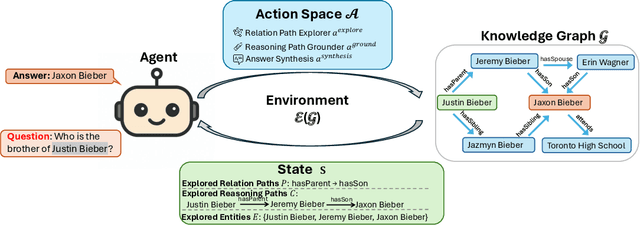

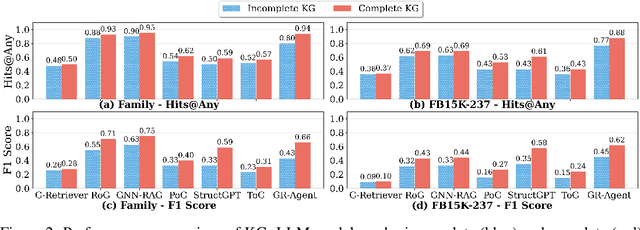
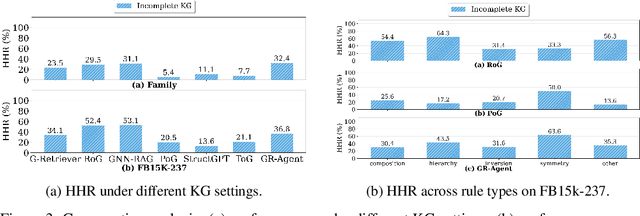
Large language models (LLMs) achieve strong results on knowledge graph question answering (KGQA), but most benchmarks assume complete knowledge graphs (KGs) where direct supporting triples exist. This reduces evaluation to shallow retrieval and overlooks the reality of incomplete KGs, where many facts are missing and answers must be inferred from existing facts. We bridge this gap by proposing a methodology for constructing benchmarks under KG incompleteness, which removes direct supporting triples while ensuring that alternative reasoning paths required to infer the answer remain. Experiments on benchmarks constructed using our methodology show that existing methods suffer consistent performance degradation under incompleteness, highlighting their limited reasoning ability. To overcome this limitation, we present the Adaptive Graph Reasoning Agent (GR-Agent). It first constructs an interactive environment from the KG, and then formalizes KGQA as agent environment interaction within this environment. GR-Agent operates over an action space comprising graph reasoning tools and maintains a memory of potential supporting reasoning evidence, including relevant relations and reasoning paths. Extensive experiments demonstrate that GR-Agent outperforms non-training baselines and performs comparably to training-based methods under both complete and incomplete settings.
Defect-aware Hybrid Prompt Optimization via Progressive Tuning for Zero-Shot Multi-type Anomaly Detection and Segmentation
Dec 10, 2025
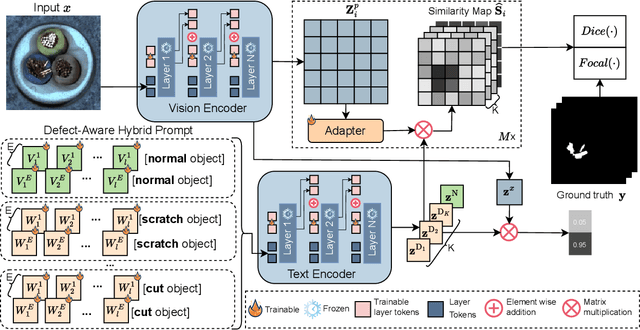
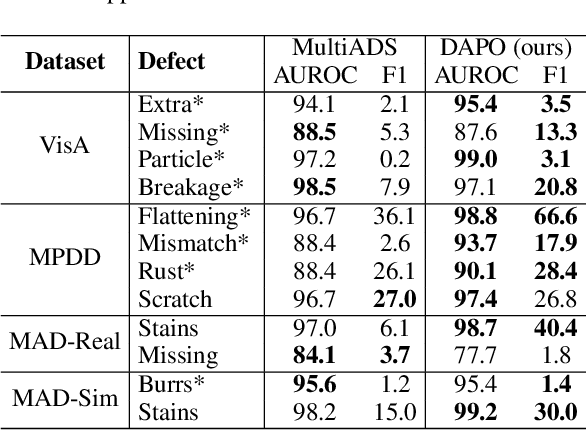
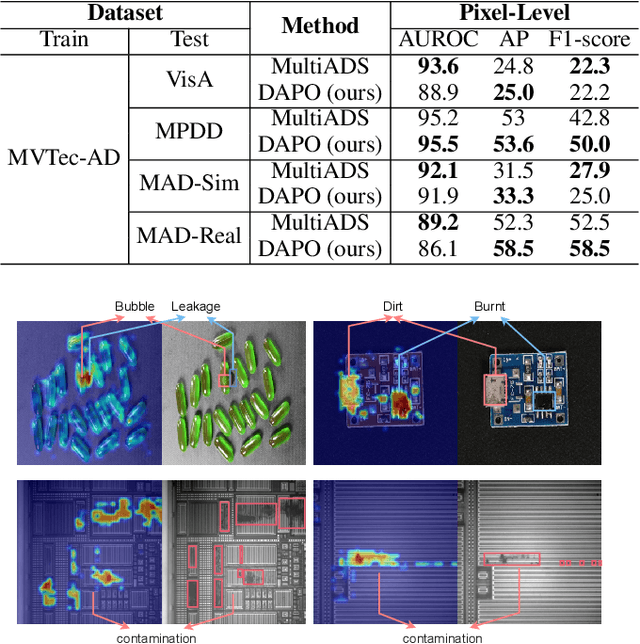
Recent vision language models (VLMs) like CLIP have demonstrated impressive anomaly detection performance under significant distribution shift by utilizing high-level semantic information through text prompts. However, these models often neglect fine-grained details, such as which kind of anomalies, like "hole", "cut", "scratch" that could provide more specific insight into the nature of anomalies. We argue that recognizing fine-grained anomaly types 1) enriches the representation of "abnormal" with structured semantics, narrowing the gap between coarse anomaly signals and fine-grained defect categories; 2) enables manufacturers to understand the root causes of the anomaly and implement more targeted and appropriate corrective measures quickly. While incorporating such detailed semantic information is crucial, designing handcrafted prompts for each defect type is both time-consuming and susceptible to human bias. For this reason, we introduce DAPO, a novel approach for Defect-aware Prompt Optimization based on progressive tuning for the zero-shot multi-type and binary anomaly detection and segmentation under distribution shifts. Our approach aligns anomaly-relevant image features with their corresponding text semantics by learning hybrid defect-aware prompts with both fixed textual anchors and learnable token embeddings. We conducted experiments on public benchmarks (MPDD, VisA, MVTec-AD, MAD, and Real-IAD) and an internal dataset. The results suggest that compared to the baseline models, DAPO achieves a 3.7% average improvement in AUROC and average precision metrics at the image level under distribution shift, and a 6.5% average improvement in localizing novel anomaly types under zero-shot settings.
The Illusion of Diminishing Returns: Measuring Long Horizon Execution in LLMs
Sep 11, 2025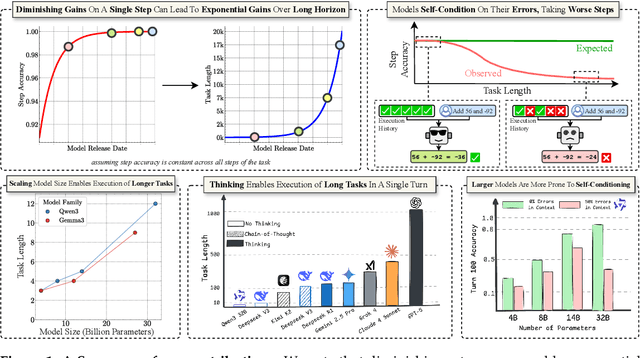
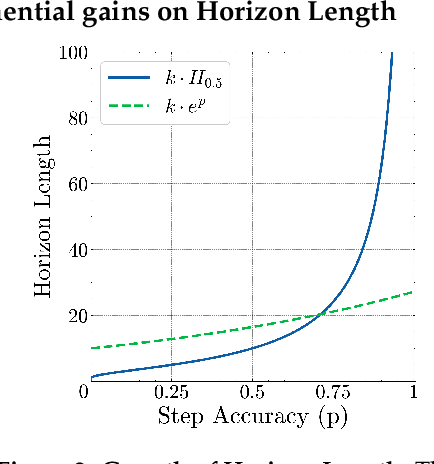
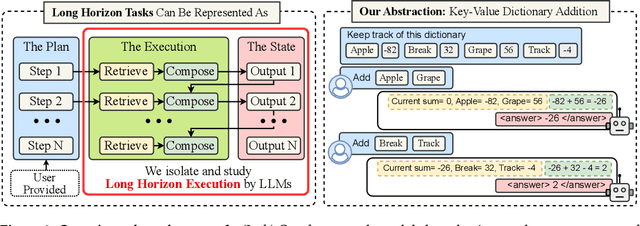
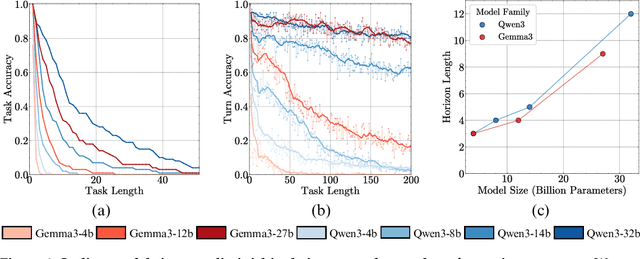
Does continued scaling of large language models (LLMs) yield diminishing returns? Real-world value often stems from the length of task an agent can complete. We start this work by observing the simple but counterintuitive fact that marginal gains in single-step accuracy can compound into exponential improvements in the length of a task a model can successfully complete. Then, we argue that failures of LLMs when simple tasks are made longer arise from mistakes in execution, rather than an inability to reason. We propose isolating execution capability, by explicitly providing the knowledge and plan needed to solve a long-horizon task. We find that larger models can correctly execute significantly more turns even when small models have 100\% single-turn accuracy. We observe that the per-step accuracy of models degrades as the number of steps increases. This is not just due to long-context limitations -- curiously, we observe a self-conditioning effect -- models become more likely to make mistakes when the context contains their errors from prior turns. Self-conditioning does not reduce by just scaling the model size. In contrast, recent thinking models do not self-condition, and can also execute much longer tasks in a single turn. We conclude by benchmarking frontier thinking models on the length of task they can execute in a single turn. Overall, by focusing on the ability to execute, we hope to reconcile debates on how LLMs can solve complex reasoning problems yet fail at simple tasks when made longer, and highlight the massive benefits of scaling model size and sequential test-time compute for long-horizon tasks.
What Breaks Knowledge Graph based RAG? Empirical Insights into Reasoning under Incomplete Knowledge
Aug 11, 2025Knowledge Graph-based Retrieval-Augmented Generation (KG-RAG) is an increasingly explored approach for combining the reasoning capabilities of large language models with the structured evidence of knowledge graphs. However, current evaluation practices fall short: existing benchmarks often include questions that can be directly answered using existing triples in KG, making it unclear whether models perform reasoning or simply retrieve answers directly. Moreover, inconsistent evaluation metrics and lenient answer matching criteria further obscure meaningful comparisons. In this work, we introduce a general method for constructing benchmarks, together with an evaluation protocol, to systematically assess KG-RAG methods under knowledge incompleteness. Our empirical results show that current KG-RAG methods have limited reasoning ability under missing knowledge, often rely on internal memorization, and exhibit varying degrees of generalization depending on their design.
Mathematical Reasoning for Unmanned Aerial Vehicles: A RAG-Based Approach for Complex Arithmetic Reasoning
Jun 05, 2025Autonomous UAV operation necessitates reliable mathematical reasoning for tasks such as trajectory planning and power management. While traditional flight control relies on hardcoded equations, recent Large Language Models (LLMs) offer potential for more flexible problem-solving but struggle with reliably selecting and applying correct mathematical formulations and executing precise multi-step arithmetic. We propose RAG-UAV, a retrieval-augmented generation framework designed to improve the mathematical reasoning of several LLMs (including GPT o1/Turbo, Llama-3.2/3.3, Mistral, and DeepSeek R1) in UAV-specific contexts by providing access to relevant domain literature. To conduct an initial assessment, we introduce the UAV-Math-Bench, a small problem set comprising 20 UAV-centric mathematical problems across four difficulty levels. Our experiments demonstrate that incorporating retrieval substantially increases exact answer accuracy (achieving up to 75% with o1), reduces instances of incorrect formulation selection (from 25% without RAG to 5% with RAG), decreases numerical errors, reducing Mean Squared Error (MSE) by orders of magnitude for the best-performing models. This pilot study indicates that RAG can enable general-purpose LLMs to function as more reliable tools for engineering analysis, although direct real-time flight control requires further investigation and validation on a larger scale. All benchmark data, question and answer are publicly available.